From The All-New Speeder’s Guide to Avoiding Tickets
Don’t argue with the cop. Fight the D-A-M-N ticket!
Next time you get stopped, use the D-A-M-N System!
Flashing lights. Pounding heart. A $250 fine that turns into years of higher insurance. You can’t out-argue the officer on the shoulder — but you can give them every reason to let you go with a warning. Four letters. Ninety seconds. One system you’ll actually remember when it counts.
- Instant digital download
- Book + checklists + audio
- Secure checkout by Gumroad
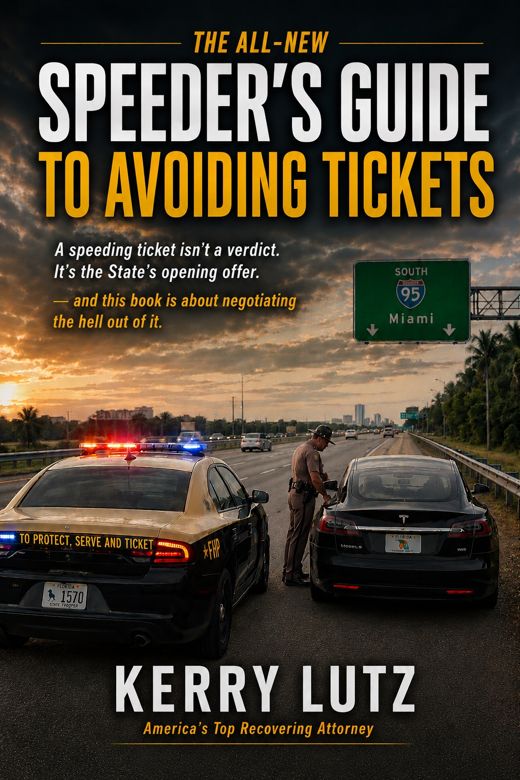
By Kerry Lutz · Retired attorney
Introducing The D-A-M-N System.
When the lights hit your mirror, your brain goes to mush. That’s exactly why the core technique in The All-New Speeder’s Guide to Avoiding Tickets fits into four letters you can recall under pressure.
-
De-escalate
Lower the tension from the moment the flashing lights appear.
-
Admit
Acknowledge your mistake rather than arguing with the officer.
-
Mitigate
Give the officer a legitimate reason to exercise discretion.
-
NOW!
Use the system immediately, before the encounter becomes adversarial.
The officer has discretion. The D-A-M-N System is how you earn it — not with tricks, lies, or courtroom speeches on the shoulder, but with a sequence of moves that makes a warning the easiest decision of their shift.
Instant download. One payment. No subscription.
Seven traffic stops. Five warnings. Two conditional discharges. Zero points.
- Stops
- 7
- Warnings
- 5
- Conditional discharges
- 2
- Points
- 0
“In 14 years of driving in Florida, I’ve been stopped seven times. Five encounters ended in warnings. The other two tickets were ultimately resolved through conditional discharges. No points. No insurance surcharges.
My latest stop, on September 1, 2026, ended with an official written warning. I used the principles behind the D-A-M-N System, and here’s the actual police document.”
- Issued by: Palm Beach Gardens Police Department
- Date: Tuesday, September 1, 2026
- Outcome: Written warning — no fine, no points
- The officer’s instruction: “Your only required action is to exercise safer driving habits in the future.”
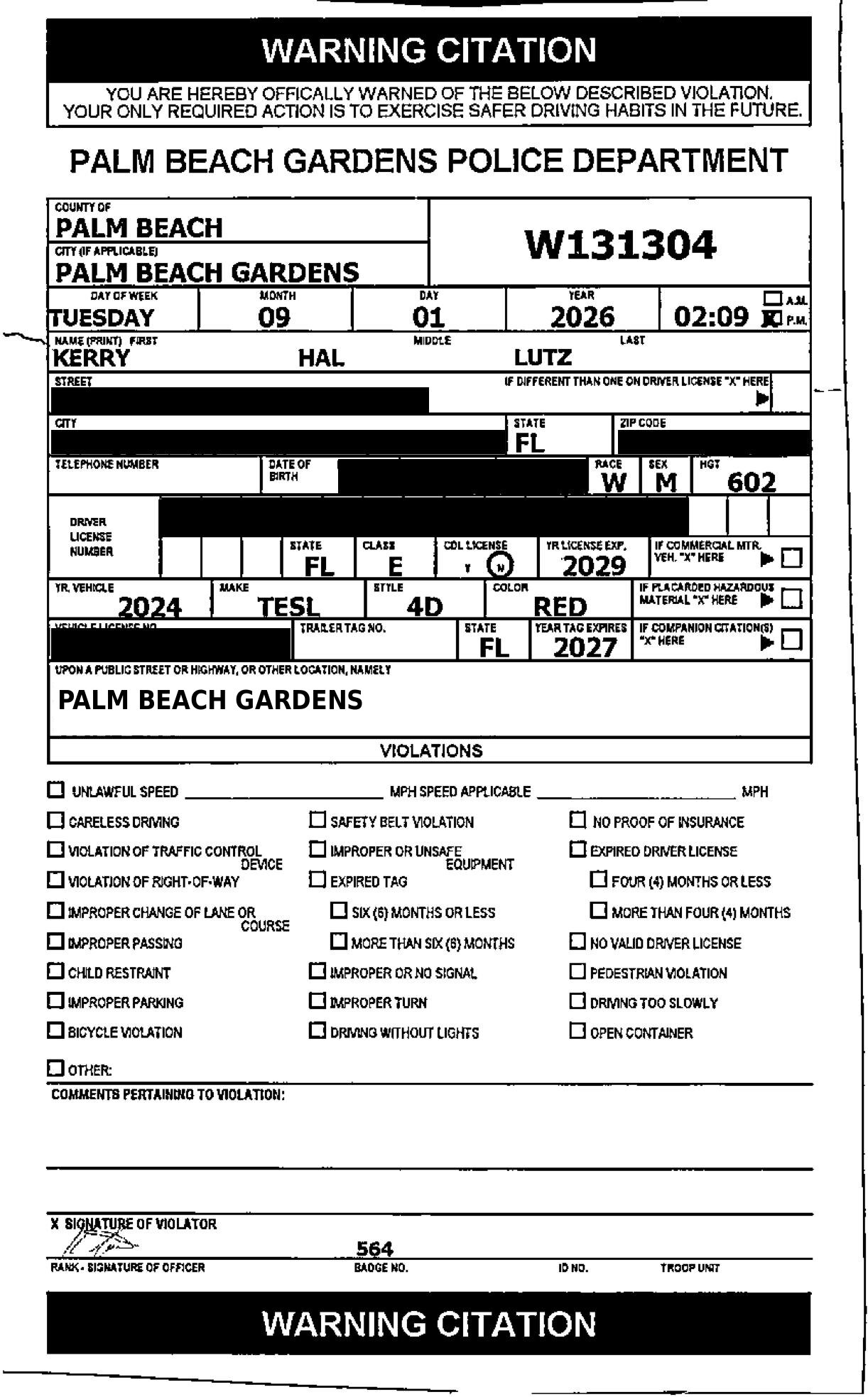
This document is evidence of one actual outcome. It is not a guarantee of future results, and it is not an endorsement of the D-A-M-N System by the Palm Beach Gardens Police Department or any law enforcement agency. Every stop is different, and the decision always belongs to the officer.
Learn exactly what I do from the moment the lights come on.
That $250 speeding ticket could end up costing you $2,500.
The fine is just the cover charge. The expensive part shows up months later in your insurance renewal — and then again, every renewal, for years.
Illustrative figures. Your state, insurer, driving record and charged speed determine the real number — and for some drivers it’s higher.
You’re up against an industry.
Forty-one million speeding tickets are issued every year — one every second — generating $6.2 billion in revenue for an assembly line of cops, judges, court clerks, radar manufacturers, camera vendors, and insurance actuaries. Paying the fine online is a guilty plea, and the mail-in envelope is the most profitable product the system sells.
The Speeding Ticket Survival System is your counteroffer.
The complete package helps you prepare before you’re ever stopped, handle the stop itself with the D-A-M-N System, understand your options if a ticket is written anyway, and work toward a better outcome — a warning, a reduction, a conditional discharge, or a dismissal — instead of a conviction that follows you for years.
It costs $24.95. One avoided ticket can save you a hundred times that.
Three tools. One D-A-M-N system.
Each component covers a different moment — before the stop, during the stop, and after. Together they form a complete strategy for surviving the Speeding-Industrial Complex.
- The D-A-M-N System
- Radar, laser & camera tactics
- Courtroom strategy
- The $250/$2,500 math
- Vehicle ID — day & night
- The story of Firestarter Nat
- Glove Box Checklist
- Court Prep Checklist
- Post-Ticket Action Plan
- Print them, keep them
- Every chapter & story
- Hands-free learning
- Built for the road
- Commute-ready
A complete strategy — not a theory.
Seven stops in fourteen years of Florida driving. Five warnings. Two conditional discharges. Zero points. Zero insurance damage. That's not luck. That's the D-A-M-N System — and everything that backs it up.
- The D-A-M-N SystemDe-escalate, Admit, Mitigate — NOW! The four-letter roadside technique built to move the officer’s discretion toward a warning. Plus the one question you must ask every time.
- The $250 Ticket That Costs $2,500The insurance math nobody does at the roadside. A single conviction raises your premium 20–30% for up to eleven years.
- Adjourn, Adjourn, AdjournWhy the calendar is your best lawyer, why troopers no-show more than local cops, and how running out the clock saves licenses.
- Know What You're Looking AtHow to spot a Charger, an Explorer, or an undercover funny car — day or night — before it spots you.
- The Psychology of a Traffic StopWhy the officer doesn't care who gets the ticket. Why mercy is a decision you can influence.
- The Town FixerThe courthouse insider most drivers never know exists — and three ways to find him.
- Your Vehicle Has a ReputationWhy a minivan at 80 mph is invisible while a Dodge Demon gets a ticket sitting at the curb.
- What Doesn't WorkSovereign citizens, fake emergencies, arguing, and the true story of asking a trooper "Have you been drinking?"
What readers are saying.
The definitive blueprint for the modern driver.
If you grew up reading James Eagan's classic guide, you already know the foundational psychology of dealing with speed traps. But let's be honest—the road has completely changed since the 1990s. We aren't dealing with simple radar guns anymore; we are dealing with an automated, industrial-scale revenue machine backed by predatory insurance algorithms.
This book is the definitive, 2026-ready update the culture has been starving for. The author beautifully modernizes the game, breaking down exactly how to navigate everything from modern LIDAR and digital pacing to the underlying mechanics of traffic stops. As the book perfectly puts it: "A speeding ticket isn't a verdict. It's the opening offer delivered by an armed agent in Raybans."
Beyond the tactical advice, it has incredible soul—the stories (like Firestarter Nat) keep you hooked, and the data exposing the insurance scam will make your blood boil. If you are a car enthusiast, a commuter, or anyone tired of being treated like a moving piggy bank by local municipalities, buy this book and drop it straight into your glovebox. Essential reading!
Firestarter Nat
My father Nat Lutz was a habitual speeder.
During World War II, Nat Lutz flew The Hump — the legendary air route over the Himalayas. The weather killed crews. The mountains killed crews. Sometimes the Japanese helped.
Nat survived. He came home, raised a family, built houses — and buried the speedometer needle on every major highway in New Jersey. He once blew past a Georgia trooper doing triple digits, then pulled into an orange juice stand just over the Florida border, taking care to hide his car around back — and watched, calmly sipping his OJ, as the trooper passed by several minutes later with lights flashing and siren blaring. He measured his eyesight by how far away he could spot a radar trap.
His driving was never about speed. It was about awareness. And if there is a patron saint of habitual speeders, his name is Firestarter Nat.
His story opens the book.
Don’t wait until you see flashing lights. Learn the D-A-M-N System today!
Don’t argue with the cop. Fight the D-A-M-N ticket! Use the D-A-M-N System.
Get the D-A-M-N System — $24.95 Get the Book on AmazonLess than a tank of gas. A fraction of what one ticket costs.
Get the D-A-M-N System — $24.95
The complete Speeding Ticket Survival System: book, checklists, and audio companion in one order. Instant download, one payment, no subscription. Payment is processed by Gumroad, so your card details never touch this site.
- The Book — The All-New Speeder's Guide to Avoiding Tickets, 26 chapters, featuring the D-A-M-N System
- The Checklists — three printable PDFs: glove box, court prep, post-ticket
- The Audio Companion — every chapter as a deep-dive podcast
Checkout not loading? Open the order form in a new tab.
Just want the Kindle ebook on its own?
Get the Book on AmazonThe Roadside Stop Checklist: 5 things you never do — and the one question you always ask.
The checklist covers the ninety seconds that decide how the rest of your case goes — the five things that make a ticket inevitable, and the one question to ask after it is written. Enter your email below and it opens right here on this page.
Enter your email to open the checklist
Press Enter or tap the button and the checklist opens immediately. We send the occasional ticket-fighting tip — no spam, unsubscribe from any email.
The Roadside Stop Checklist is unlocked for this visit.
The Roadside Stop Checklist
Everything below is free: how traffic stops, points, insurance surcharges, Super Speeder laws and traffic court actually work. The D-A-M-N System gets you through the stop. This gets you through everything after it.
Start with the moment you're standing in.
The system runs from the mirror to the courthouse. Each guide covers one stage of it in full — what to do, what it costs, and where the leverage is.
The traffic stop is where the case is won or lost.
Everything that happens in traffic court is built on the ninety seconds you spend at the side of the road. The officer decides whether to write a warning or a citation, which speed to write down, and what to remember six months later. Those are all decisions you can influence.
The first sixty seconds
Signal, pull as far right as the shoulder safely allows, and stop somewhere the officer can stand without traffic at their back. Turn the engine off. At night, switch on the interior dome light. Roll the window down. Put both hands on the top of the wheel and leave them there. Every one of those moves reduces the officer's threat assessment before a word is spoken — and a calm approach is the precondition for every good outcome that follows.
Do not reach for the glove box, your wallet, or the center console until you are asked. Announce where the documents are and wait for permission to retrieve them. Most jurisdictions require you to produce a driver's license, vehicle registration, and proof of insurance on request.
What not to do
Arguing the speed limit, disputing the radar reading, claiming an emergency you cannot document, or reciting sovereign-citizen theories does not work. It converts a discretionary decision into a defensive one. The officer who was deciding between a warning and a ticket stops deciding. Worse, everything you say is a statement against interest that can be repeated in court by a witness with a notebook and a body camera.
The roadside is not the venue for your defense. Preserve the argument for a room with a prosecutor in it.
Searches, questions, and the scope of the stop
A traffic stop is a brief detention for a specific purpose. Officers may order you and your passengers out of the vehicle, and a stop made for a genuine traffic violation is lawful even if the officer had other suspicions. But the stop cannot be extended indefinitely: once the business of the citation is finished, prolonging the detention to investigate something else requires independent reasonable suspicion.
You are not obligated to consent to a vehicle search, and declining consent politely is not evidence of wrongdoing. Officers do not need to read you Miranda warnings during an ordinary roadside stop, which means casual conversation is still on the record. "I'd rather not answer questions" and "I don't consent to a search" are complete sentences.
Before you drive away
Read the citation before you leave the shoulder. Note the charged speed, the alleged limit, the statute cited, the measurement method, the officer's name and badge number, the unit number, the exact location, and the court date and deadline. Photograph the scene — signage, sightlines, lane configuration, weather, and where the patrol car was parked. Those details are perishable and they are frequently the whole case.
Go deeper: the full step-by-step procedure is in what to do when you get pulled over, and the language for the conversation itself is in what to say to police during a traffic stop.
Not legal advice. This page is general education about how traffic enforcement, licensing, and insurance rating work in the United States. Statutes, thresholds, and court procedures vary by state and change often. For advice about a specific citation, consult a licensed attorney in the jurisdiction where it was issued.
The fine is the cheapest part of a speeding ticket.
The number printed on the citation is the only cost most drivers ever calculate. It is routinely the smallest line item. The expensive part arrives months later, in an insurance renewal notice, and then arrives again every renewal cycle for years.
How a conviction becomes a surcharge
A speeding conviction is reported by the court to your state's licensing agency, which records it on your motor vehicle record — the MVR — and, in most states, assigns demerit points. When your policy renews, your insurer pulls that MVR and re-rates you. Because you no longer qualify as a clean-record driver, you lose safe-driver and good-driver discounts, and a violation surcharge is applied on top. Two things happen at once: a discount disappears and a penalty appears. That is why the increase is so much larger than drivers expect.
Most carriers surcharge a single speeding violation for three to five years, and some look back longer. Accumulate points and the effects compound: enough of them and you are moved into a high-risk tier or a nonstandard carrier, and in some states you are billed a separate statutory insurance surcharge by the state itself, independent of anything your insurer does.
| Cost | Typical range | When it hits |
|---|---|---|
| Fine on the citation | $100 – $400 | Immediately |
| Court costs & administrative fees | $40 – $200 | At disposition |
| State enhancement fee (e.g. Georgia Super Speeder) | $0 – $200 | Billed separately, after conviction |
| Lost safe-driver discount | 10% – 20% of premium | Next renewal, for 3 – 5 years |
| Violation surcharge | 20% – 30% of premium | Next renewal, for 3 – 5 years |
| State point surcharge (e.g. New Jersey) | $150 + $25 per point over 6, for 3 years | Assessed by the state |
| Traffic school or point-reduction course | $25 – $100 | Optional, often worth it |
| Time off work for court | 1 – 2 days | Per appearance |
Why "just pay it" is the expensive option
Paying the fine online is a guilty plea. It is fast, it is frictionless by design, and it converts an accusation into a conviction on your record with points attached. The mail-in envelope is the single most profitable product the system sells. Any disposition that avoids the conviction — a reduction to a non-moving violation, a withheld adjudication, traffic school, a deferral, or a dismissal — is usually worth several times the fine in avoided premium.
Commercial drivers are a special case
If you hold a CDL, the ordinary playbook changes. Speeding 15 mph or more over the limit is a serious traffic violation under federal rules, and two serious violations in three years disqualifies your CDL for 60 days. Federal masking rules also bar states from letting CDL holders hide a conviction through traffic school or deferred adjudication — options that are freely available to everyone else. A CDL holder should treat any moving violation as a threat to their livelihood and get counsel early.
Go deeper: the full arithmetic, the four separate clocks, and the dispositions that stop the surcharge before it starts are in what a speeding ticket really costs.
Past a certain number, it stops being a ticket.
Every state draws a line where speeding stops being an infraction and becomes something worse — an enhanced fee, a misdemeanor, a criminal record, or an automatic suspension. Cross it and the ordinary strategy of paying the fine and moving on is no longer available to you.
Georgia's Super Speeder law
Georgia's Super Speeder law is the best-known example, and the most widely misunderstood. It is not a separate charge and an officer cannot write you a ticket for it. It is a state fee applied after conviction: if you are convicted of speeding at 75 mph or more on a two-lane road, or 85 mph or more on any road in Georgia, the Department of Driver Services bills you an additional $200 on top of whatever the local court already collected.
Three details catch drivers out. First, the bill arrives separately, weeks after the case is closed, mailed to the address on your license — so drivers who have moved never see it. Second, you have 120 days from the notice to pay, and if you do not, your license or driving privilege is suspended and reinstatement costs another $50. Third, it applies to out-of-state drivers passing through: Georgia suspends your privilege to drive in Georgia, and your home state may act on the suspension in turn.
Where the line sits in other states
| State | Threshold | What changes |
|---|---|---|
| Georgia | 75+ mph on a two-lane road; 85+ mph anywhere | Super Speeder: extra $200 state fee, suspension if unpaid within 120 days |
| Virginia | 85+ mph at any limit, or 20+ mph over | Reckless driving by speed — a Class 1 misdemeanor, not a traffic infraction. Jail and a criminal record are on the table |
| Illinois | 26–34 mph over; 35+ mph over | Aggravated speeding: Class B and Class A misdemeanor respectively — criminal charges, not payable by mail |
| California | Over 100 mph | Enhanced fine, 2 points, and license suspension exposure on a first offense |
| New York | 41+ mph over | 11 points at once — enough to trigger suspension on a single ticket |
| New Jersey | 6+ points on your record | A state-assessed insurance surcharge, separate from your carrier's own increase |
| North Carolina | 15+ mph over while above 55 mph; 80+ mph | License revocation exposure and reckless driving charges |
| Florida | 30+ mph over; 50+ mph over | Mandatory court appearance; at 50+ over, sharply escalating fines and revocation on repeat offenses |
| Texas | Varies by court | No state point system since 2019, but very high speeds routinely disqualify you from the deferred-disposition programs that would otherwise keep the conviction off your record |
Work zones, school zones, and doubled penalties
Almost every state enhances penalties for speeding in an active work zone or a marked school zone, typically by doubling the fine and sometimes by adding points or removing the option of traffic school. Enhancements usually apply whether or not workers or children were actually present, because the sign — not the circumstance — defines the zone. These are also the locations where automated enforcement is most likely to be deployed and hardest to contest.
Radar, LIDAR, cameras, and the stopwatch.
You cannot evaluate a speeding case without knowing how the number was produced. Each method has a different error profile, a different paper trail, and a different set of things that have to go right for the reading to be admissible.
Bounces a radio beam off your vehicle and reads the frequency shift. X-band is nearly extinct, K-band persists, and Ka-band is the modern standard. The beam is wide, which means it can read the largest reflective object in its path rather than your car, and "instant-on" operation exists specifically to defeat detectors.
An infrared pulse measures distance many times per second and derives speed. The beam is only a few feet wide at a thousand feet, so it is far harder to misattribute than radar — but it requires clear line of sight, a steady hand, and a stationary operator. Aiming and tracking-history requirements are where these cases are attacked.
Visual Average Speed Computer and Recorder: the officer times you between two fixed points and divides. It emits nothing, so no detector on the market will see it. Its accuracy depends entirely on human reaction time at both ends of the measurement, which is precisely the vulnerability.
The officer follows and matches your speed, then reads their own speedometer. Common on rural highways and in unmarked units. The case rests on the patrol car's speedometer calibration records and on whether a constant distance was genuinely maintained long enough to matter.
Those white highway stripes are timing marks. A spotter aloft clocks you between them and radios a ground unit to make the stop. The signs warning of it are not a bluff, and the officer who pulls you over never saw your speed at all.
Fixed speed cameras, mobile camera vans, red light cameras with a speed function, and average-speed systems that pair plate reads at two points to compute your speed across miles of road. Notice arrives by mail. Depending on the state these are civil penalties against the registered owner, sometimes with no points attached.
Automatic license plate readers on patrol cars, overpasses, and toll gantries log where your plate has been. It is not speed enforcement by itself, but it is the reason "they had no way to know" is rarely a safe assumption anymore.
Radar detectors are legal in private passenger vehicles in every state except Virginia, and are barred by federal rule in commercial vehicles over 10,000 pounds. Radar jammers are illegal nationwide under FCC rules. Laser jammers occupy a state-by-state grey area. A detector warns you; it does not undo a reading already taken.
The practical point is that every one of these methods generates records — calibration certificates, operator training and certification, tuning-fork tests, tracking history, maintenance logs, camera commissioning reports. Those records are obtainable, and their absence is frequently more useful than any argument about how fast you were actually going.
Go deeper: the device-by-device breakdown, including which error modes belong to which machine, is in radar vs. laser speeding tickets.
You have more moves than pay or fight.
Drivers imagine two doors: mail in the fine, or stand up in court and lose. In reality most citations are resolved somewhere in between, through procedures that exist precisely because the system cannot afford to try every case.
In most courts the prosecutor, not the officer, controls the offer. Reductions to a lower speed, to a non-moving violation, or to a disposition with no points are routine for drivers with clean records who show up prepared and polite. In a few venues — New York City's Traffic Violations Bureau most famously — there is no prosecutor and no plea bargaining at all.
Defensive driving and point-reduction courses can keep a conviction off your record or strip points and earn an insurance discount. Eligibility is usually limited by charged speed, by how recently you last used it, and by a lifetime cap. Almost always the cheapest good outcome available.
Deferred adjudication or disposition in Texas and elsewhere, withheld adjudication in Florida, a prayer for judgment continued in North Carolina, a conditional discharge in other jurisdictions: different names for the same idea — complete a condition, and no conviction is entered for licensing or insurance purposes. Each has its own eligibility limits and household or per-period caps.
Some states offer a hearing where you concede the violation and argue only about consequences. You are not disputing the radar; you are asking for a reduced fine, a payment plan, or a deferral. A low-risk option when the evidence against you is solid.
California and a handful of other jurisdictions let you contest by mail. You submit a written statement, the officer submits one, and a judge decides on the paper. If the officer does not respond, you win without appearing — and a loss usually preserves your right to a new trial in person.
Request the officer's notes, the radar or LIDAR unit's calibration and maintenance records, the operator's training certification, the daily tuning-fork test, dashcam and bodycam footage, and the camera system's commissioning report. What comes back incomplete is your case.
Continuances and adjournments are not stalling, they are strategy. Officers transfer, retire, get promoted, deploy, and take vacation. Memories decay and notebooks get lost. The witness who does not appear cannot testify, and cases collapse for reasons that have nothing to do with speed.
Ignoring a ticket from another state does not make it disappear. Under the Driver License Compact most states report convictions to your home state, and under the Non-Resident Violator Compact they will suspend your license if you simply fail to appear. A few states are outside these agreements, which is a fact worth knowing rather than gambling on.
Go deeper: the paperwork sequence from citation to disposition is in how to fight a speeding ticket, and how the room itself actually works is in traffic court strategy.
Speeding tickets, points, and surcharges.
The questions drivers ask after the lights come on — answered plainly. General information only, not legal advice; verify the rules for your own state.
Does a speeding ticket raise your car insurance?
Almost always, yes — but not immediately. The conviction is reported to your state licensing agency and lands on your motor vehicle record. The increase appears at your next policy renewal, when your insurer re-pulls that record, removes your safe-driver discount and applies a violation surcharge. Because a discount disappears at the same moment a penalty is added, the combined effect is commonly a 20% to 30% premium increase.
How long does a speeding ticket affect your insurance rates?
Most carriers surcharge a single speeding violation for three to five years from the conviction date, and some use a longer look-back period. That is why the total cost of a ticket is usually several times the printed fine: a $250 citation that adds $400 a year to a policy for four years costs about $1,850 on top of the fine.
What is an insurance surcharge?
A surcharge is an extra amount added to your premium because of something on your record, such as a speeding conviction or an at-fault accident. It is separate from losing a discount, though the two usually happen together. Confusingly, a few states also assess their own statutory insurance surcharge directly — New Jersey bills drivers who reach six points $150 plus $25 for each additional point, every year for three years, entirely independent of what the insurer charges.
Should I fight a speeding ticket or just pay it?
Paying the fine is a guilty plea, and it is the option the system is designed to make easiest. It closes the case and puts a conviction with points on your record. Because the insurance consequences usually dwarf the fine, it is worth at least appearing to ask for a reduction, a deferral, or traffic school — dispositions that are routinely granted to drivers with clean records who show up prepared. Fighting on the facts is a separate question that depends on how your speed was measured.
What is the Super Speeder law in Georgia?
Georgia's Super Speeder law adds a $200 state fee for anyone convicted of speeding at 75 mph or more on a two-lane road, or 85 mph or more on any road in Georgia. It is not a charge an officer can write — it is applied by the Department of Driver Services after conviction, and billed separately from the fine the local court already collected. It adds no points of its own; the points come from the underlying speeding conviction.
Does the Georgia Super Speeder fee apply to out-of-state drivers?
Yes. Georgia bills out-of-state drivers the same $200 fee and mails the notice to the address on your license, which is why drivers who have moved often never receive it. You have 120 days from the notice to pay. If you do not, Georgia suspends your privilege to drive in the state, reinstatement costs an additional $50, and your home state may act on the suspension as well.
When does speeding become reckless driving?
It depends entirely on the state, and the threshold is often lower than drivers assume. In Virginia, driving 85 mph or more at any speed limit — or more than 20 mph over the limit — is reckless driving by speed, a Class 1 misdemeanor carrying possible jail time and a criminal record rather than a traffic infraction. Illinois treats 26 to 34 mph over as a Class B misdemeanor and 35 mph or more over as a Class A misdemeanor. At those levels you are in criminal court and should have a lawyer.
How long do points stay on your license?
Typically two to three years from the violation or conviction date, though several states use longer periods and a few use rolling windows that measure points accumulated within a set span. Points and convictions are tracked separately: points may expire while the conviction itself remains visible on your driving record for considerably longer. Texas has had no state point system at all since the Driver Responsibility Program was repealed in 2019.
How long does a speeding ticket stay on your driving record?
In most states a speeding conviction stays on the motor vehicle record for three to five years, and some states keep it substantially longer or permanently for serious offenses. This is a different clock from the points clock and from your insurer's rating period, so a ticket can still be visible on your record after it has stopped affecting your premium.
What should you do during a traffic stop?
Signal, pull as far to the right as the shoulder safely allows, and stop where the officer is not standing in traffic. Switch the engine off, turn on the interior light if it is dark, lower the window, and keep both hands visible on top of the wheel. Wait to be asked before reaching for documents, and say where they are before you reach. Be brief and civil. Nearly every discretionary decision an officer makes is influenced in the first sixty seconds.
Do you have to answer questions during a traffic stop?
You generally must identify yourself and produce your license, registration and proof of insurance. Beyond that you are not required to answer investigative questions, and you are not required to consent to a search of your vehicle. Miranda warnings are not required during a routine roadside stop, which means anything you volunteer can be used later. Declining politely is not itself evidence of wrongdoing.
Can a speeding ticket be dismissed?
Yes, and it happens more often than most drivers expect — though rarely because someone out-argued a radar gun. Dismissals typically come from procedural failures: the officer does not appear, the citation contains a fatal defect, the calibration or operator-certification records cannot be produced, or the case is continued until the evidence is stale. This is why requesting discovery and using continuances matters more than debating your speed.
Does traffic school remove points from your license?
In many states a defensive driving or point-reduction course either prevents the points from attaching or removes points already assessed, and it often earns a separate insurance discount. Eligibility is usually restricted by how fast you were charged with going, how recently you last used the option, and a lifetime or per-period cap. It is generally the cheapest good outcome available, so ask about it before agreeing to anything else.
Are radar detectors legal?
Radar detectors are legal in private passenger vehicles in every U.S. state except Virginia, and federal rules prohibit them in commercial vehicles over 10,000 pounds. Radar jammers are illegal nationwide under FCC rules. Laser jammers are permitted in some states and banned in others. Note also that a detector cannot warn you about VASCAR, pacing, aircraft enforcement, or camera systems, because none of those emit anything to detect.
Do speed camera tickets add points to your license?
Usually not, but it varies by state and by program. Many automated enforcement schemes are structured as civil penalties against the registered owner of the vehicle rather than moving violations against a driver, which means no points and often no insurance consequence. That also makes them harder to contest, since the state does not have to prove who was driving.
What happens if you ignore a speeding ticket from another state?
It does not go away. Under the Non-Resident Violator Compact, the issuing state notifies your home state and your license is suspended for failing to appear or pay. Under the Driver License Compact, most states report the conviction itself back to your home state, which then applies its own points and penalties. A handful of states sit outside one or both agreements, but that is a poor thing to gamble a license on.
Does a speeding ticket affect a CDL holder differently?
Significantly. Speeding 15 mph or more over the limit is a serious traffic violation under federal regulations, and two serious violations within three years disqualifies a commercial driver's license for 60 days. Federal masking rules also prohibit states from allowing CDL holders to use traffic school or deferred adjudication to keep a conviction off the record — remedies available to everyone else. Commercial drivers should treat any moving violation as a threat to their employment.
What is the difference between a moving and a non-moving violation?
A moving violation is committed while the vehicle is in motion — speeding, running a light, improper lane change — and it carries points and insurance consequences. A non-moving violation covers things like parking, equipment defects, or expired paperwork, and it typically carries no points and no rating impact. This distinction is the basis of the most common plea bargain in traffic court: the prosecutor reduces a speeding charge to a non-moving violation, you pay a comparable fine, and your insurer never sees it.
The language of the Speeding-Industrial Complex.
Every industry protects itself with vocabulary. Here is the working glossary — the terms that appear on citations, in courtrooms, on insurance declarations pages, and in the statutes that decide what your ticket is going to cost you.
- D-A-M-N System
- De-escalate, Admit, Mitigate, NOW! The four-step roadside technique at the center of The All-New Speeder’s Guide to Avoiding Tickets, built to move a discretionary decision toward a warning.
- Absolute speed law
- A limit that is violated the instant you exceed the posted number, with no argument about reasonableness available. The rule in most states.
- Adjournment / continuance
- A postponement of your court date. Repeated legitimately, it is the single most underused tool available to a cited driver.
- Aggravated speeding
- Speeding severe enough to be charged as a misdemeanor rather than an infraction. In Illinois, 26 mph or more over the limit.
- Aircraft enforcement
- Speed measured from the air between painted highway timing marks, then radioed to a ground unit that makes the stop.
- ALPR / ANPR
- Automatic license plate readers. Cameras that log plate, time and location — on patrol cars, overpasses and toll gantries.
- Basic speed law
- The rule that you must never drive faster than is safe for conditions, even when you are under the posted limit. It lets an officer cite you for driving 55 in a 65 during heavy rain.
- Bodycam / dashcam
- Recordings of the stop. Obtainable through discovery, and as capable of helping you as hurting you.
- Calibration records
- Documentation that a radar or LIDAR unit was tested and found accurate. Missing or incomplete records are a frequent cause of dismissal.
- CDL
- Commercial driver's license. Held to stricter federal standards, with speeding 15 mph or more over the limit classified as a serious traffic violation.
- CLUE report
- Comprehensive Loss Underwriting Exchange — the shared claims-history database insurers consult when they rate you.
- Conditional discharge
- A disposition where the charge is resolved without a conviction provided you satisfy a condition, such as staying violation-free for a set period.
- Deferred adjudication / disposition
- Judgment is withheld while you complete a probationary term; finish it and no conviction is entered. Common in Texas. Barred for CDL holders by federal masking rules.
- Demerit points
- The numeric penalty a state attaches to a moving-violation conviction. Accumulate enough within the state's window and your license is suspended.
- Discovery
- The formal request for the evidence against you: officer notes, calibration and maintenance logs, training certifications, and video.
- Driver License Compact
- An interstate agreement under which most states report out-of-state convictions to your home state for points and penalties.
- Failure to appear (FTA)
- Missing your court date. Typically converts a manageable ticket into a suspension, a bench warrant, and additional charges.
- High-risk / nonstandard insurance
- The expensive market you are moved into once your record disqualifies you from standard rates.
- Instant-on radar
- Radar held in standby and triggered only when a target is in range, specifically to deny detectors any advance warning.
- Ka / K / X band
- The radio bands police radar operates on. Ka-band is the current standard, K-band remains in service, and X-band is nearly extinct.
- LIDAR
- Laser speed measurement using infrared pulses. Far more precise targeting than radar, but it demands line of sight and a stationary operator.
- Masking
- Hiding a conviction from a driving record through diversion or traffic school. Federally prohibited for commercial drivers.
- Mitigation hearing
- A hearing where you concede the violation and contest only the consequences — asking for a reduced fine, a payment plan, or a deferral.
- Moving violation
- An offense committed while the vehicle is in motion. Carries points and insurance consequences, unlike a non-moving violation.
- MVR
- Motor vehicle record. The official state driving history your insurer pulls at each renewal.
- NDR / PDPS
- The National Driver Register and Problem Driver Pointer System — federal pointers that let any state see that another state has suspended you.
- Nolo contendere
- "No contest." A plea that resolves the charge without a formal admission of guilt. In some states it can be used to avoid points, but only on a limited basis.
- Non-Resident Violator Compact
- The agreement under which states suspend your license for ignoring a citation issued in another member state.
- Non-moving violation
- Parking, equipment and paperwork offenses. Usually no points and no rating impact — which makes it the target of the most common traffic-court plea bargain.
- Pacing
- An officer follows at a constant distance and reads their own speedometer. The patrol car's calibration record is the pressure point.
- Prayer for judgment continued (PJC)
- A North Carolina disposition in which the court declines to enter judgment, so the violation does not count for licensing or insurance. Strictly capped in how often it can be used.
- Presumed speed law
- A limit where exceeding the posted number is presumptive rather than conclusive evidence, leaving room to argue your speed was safe for conditions.
- Pretextual stop
- A stop made for a real traffic violation but motivated by an unrelated suspicion. Lawful under federal precedent.
- Probable cause / reasonable suspicion
- The two standards governing a stop and its scope. Reasonable suspicion justifies a brief detention; probable cause is needed for more, including most searches.
- Red light camera
- Automated intersection enforcement, sometimes with a speed function. Often a civil penalty against the registered owner rather than a moving violation.
- Reckless driving by speed
- Speed high enough to be charged as reckless driving — a criminal misdemeanor. In Virginia the threshold is 85 mph, or 20 mph over the limit.
- Speed trap
- A location chosen to maximize citations: a sudden limit drop, an obscured sign, a downhill grade, or a jurisdictional boundary just past a curve.
- SR-22
- A certificate your insurer files with the state proving you carry required coverage. Not insurance itself, and usually a marker of high-risk status.
- Super Speeder
- Georgia's post-conviction $200 state fee for speeding at 75 mph or more on a two-lane road, or 85 mph or more anywhere in the state. Applies to out-of-state drivers.
- Surcharge
- An amount added to your premium because of your record. Distinct from — and usually stacked on top of — the loss of your safe-driver discount.
- Traffic school / defensive driving
- A court-approved course that can prevent or remove points and may earn an insurance discount. Eligibility is limited by charged speed and by how recently you last used it.
- Trial by written declaration
- Contesting a citation entirely on paper, available in California and a few other jurisdictions. If the officer never files a statement, you win without appearing.
- Tuning fork test
- The daily field check of a radar unit's accuracy. Whether it was performed and logged is a standard line of attack.
- VASCAR
- Visual Average Speed Computer and Recorder. Time-over-distance measurement that emits no signal, so no detector can see it coming.
- Withheld adjudication
- A Florida disposition, typically via traffic school election, where guilt is not formally adjudicated and no points attach.
- Work zone / school zone enhancement
- Statutory penalty multipliers for speeding in a marked zone. Usually applies whether or not workers or children were present.
Don’t argue with the cop. Fight the D-A-M-N ticket!
Next time you get stopped, use the D-A-M-N System.
Get the D-A-M-N System — $24.95 Get the Book on Amazon